 dev-portal.ai
Turn your agents into an application people can work in
Your agent already works. DevPortal is the platform your team builds the user-facing app on — so the people the work lands on see every step as it happens, in their own language, and decide the things worth deciding.
Running on Google Cloud. No sign-up.An agent that hands back a verdict is a black box
It runs for minutes, touches production, and returns an answer. Everything in between is invisible to the people the workflow actually serves. Traces exist — for developers. The approver and the auditor get nothing in their language, so they either rubber-stamp the agent or refuse to adopt it.
Ungoverned authority
Broad service-account keys. No method allowlist, no scoping, no revocation.
Identity that evaporates
The change lands under the agent's credentials. Who caused it is erased two hops back.
Consent that means nothing
A blob of JSON and a Yes button. Nobody can tell what they approved.
Your agent stays yours. The platform does two jobs.
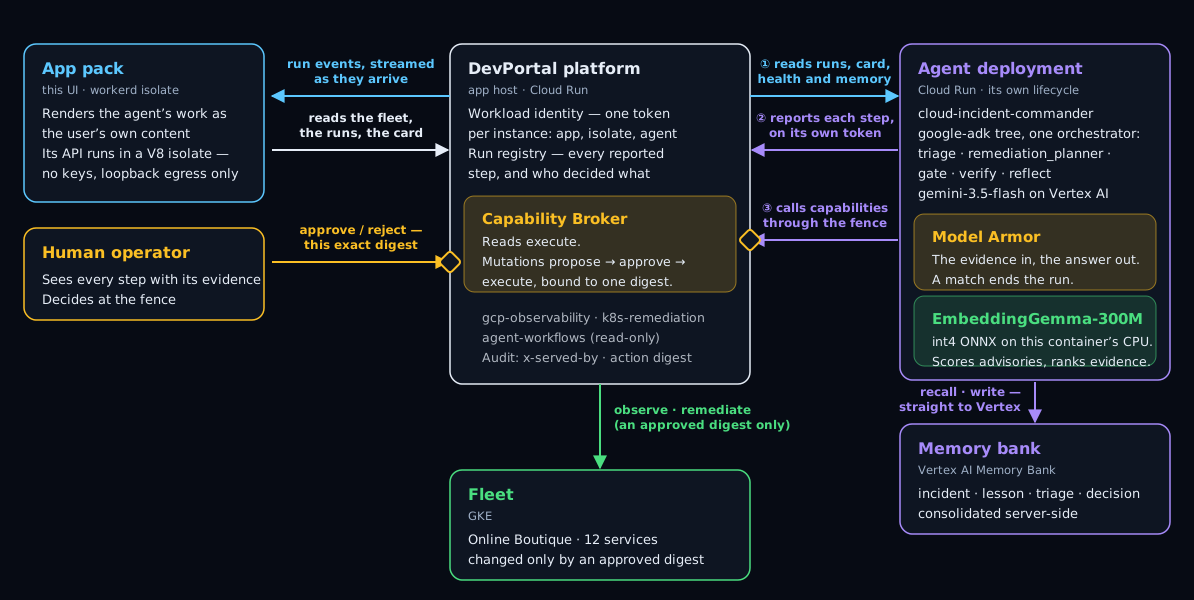
Agents stay external — deployed on Google Cloud with their own lifecycle. DevPortal never runs, retrains or locks in an agent. It reads what the agent is doing so people can watch, and every change the agent makes crosses the platform first, where policy decides: some go straight through, and the ones that matter wait for a person.
App Packs
A full-stack app dropped into the platform shell. It declares the capabilities it needs and renders the agent's work as the user's content — not a chat window.
One fence for every change
Reads execute. A change becomes a pending intent tied to its exact payload — cleared by a standing rule, or by a person. Alter the payload and the approval stops working.
Identity, not shared keys
Every deployment gets its own workload token with its own lifetime, and identity is read from the token presented at each fence — never from the request body.
Stop hand-building the same four things
Every team putting an agent in front of users builds a status screen, an approval flow, credential glue and an audit trail — once per workflow. Those come with the platform. What you write is the part that is yours: the domain views, the rules, and the actions the agent is allowed to propose.
Live run narration
Every step the agent reports reaches the browser as it happens, attributed to the part of the agent that did it.
Memory that carries over
Vertex AI Agent Engine Memory Bank in four scoped kinds. The next run reads what the last one learned before it plans.
A record that outlives the deploy
The event log is mirrored to Cloud Storage and replayed at boot, so history survives a redeployment instead of resetting with it.
Guardrails on the model call
Model Armor checks what goes into the model and what comes back, with a failure policy you can read on the agent's own card.
Agents that describe themselves
The platform asks the Agent Development Kit what a deployment is made of, and shows that answer to the people using it.
Signed, versioned releases
A pack publishes with an Ed25519 signature over its manifest and a CycloneDX SBOM resolved from the lockfile.
See it for yourself
Incident Commander is our reference App Pack, live on Google Cloud with a real agent behind it. Open it and watch the platform do its two jobs.
See the reference app incident-commander.dev-portal.ai